

A safety bulletin prepared by © IRATA International (2024)
A safety bulletin aimed at raising awareness of hazards in the rope access industry. The text provided may be of use as part of a toolbox talk. DISCLAIMER This safety bulletin – including, where given, any conclusions – is not as a result of any investigation undertaken by IRATA. The case study is based on information provided by a member company. IRATA does not attribute any blame; nor provide opinion on any root causes. Neither is any opinion expressed or implied on liability or culpability. The advice given is general in nature and provided to assist others when working in confined spaces.
1 INTRODUCTION
A member company has reported an incident that occurred in a confined space. Six vertical shafts were to be accessed in order to clean them using water jetting, before inspecting them using a Remotely Operated Vehicle. Each vertical shaft is connected to the adjacent shafts by a 30-meter long, 300mm pipe (known as an outlet toe drain or toe drain).
2 WHAT IS A CONFINED SPACE?
A ‘confined space’ means an enclosed or partially enclosed space that:
• is not designed or intended to be occupied by a person;
• is, or is designed or intended to be, at normal atmospheric pressure while any person is in the space;
• is, or is likely to be a risk to health and safety from an atmosphere that does not have a safe oxygen level;
• may hold contaminants, including airborne gases, vapours and dusts, or may cause injury, resulting from fire or explosion;
• may have harmful concentrations of any airborne contaminants; or
• may have a risk of engulfment. A space may also be considered as confined due to the limitations posed on access and egress, and the additional hazards that these limitations create.
For example, entering a large open space through a small or tightly angled opening may restrict the ease of access and any potential rescue. Whilst there may be no risk of engulfment, explosion etc., the limited access and egress itself is the hazard which requires additional consideration and controls.
3 COMMON ROPE ACCESS OPERATIONAL WORKS CARRIED OUT IN CONFINED SPACES AND CONSIDERATIONS
Rope access is often utilised in air ducts, ore bins, power station boilers, silos, ships hulls, fuel tanks and piping to carry out all manner of works including cleaning, maintenance, welding and inspection. Some confined space operations will require specific confined space training and equipment that may not be covered wholly by IRATA training.
The requirement for additional training and equipment should be identified during a specific task-based risk assessment, and these may also be mandatory requirements as specified in particular regions, regulations, or sectors. Confined space operations not only present additional hazards which require controls, they may also complicate what is planned to be a relatively straightforward rescue. Examples of this are the additional atmospheric hazards encountered in confined spaces which may be unknown or unexpected. These may result in rescuers entering a space to rescue a colleague, unaware that the hazardous atmosphere has caused the incident, subsequently causing them to succumb to the same hazard.
4 TYPICAL HAZARDS AND CONTROL MEASURES
There are a number of typical hazards and control measures that should be considered when performing confined space industrial rope access operations (see Table 1):
Table 1
| Potential hazards | Potential Controls |
| Oxygen deficiency | Monitoring of the breathing space via the use of specifically positioned and personal gas monitors. |
| Engulfment | Appropriate isolations, permits and procedures must be in place to prevent engulfment. |
| Isolated worker | 2-way radios or similar agreed and appropriate communication methods with suitable back-up protocols in place. |
| Worker injury | Appropriate and rehearsed recue plans and methods. |
| Access and egress limitations | Ensure plans and procedures are in place for all foreseeable outcomes, including evacuation of immobile protected casualty (transfer of stretcher). |
| Loss of lighting | Suitable backup lighting and emergency personal lighting (head torches). |
| Noise | Suitable hearing protection with established suitable communication method. |
| Known toxic atmosphere | Gas monitoring and the use of suitable breathing apparatus with available back-ups. |
| Dust | Masks and breathing apparatus as suitable and required. |
| Exessive heat or cold | Monitor temperature and establish protocols and procedures to be rigorously adhered to. |
| Build up or release of atmospheric hazard |
Monitor gases even in areas where these hazards are not anticipated and be prepared for a rapid exit whether evacuation or rescue. |
| Competence and capabilities | Ensure all technicians have the necessary training and competence to work in a confined space and have no known contra-indications of suitability for this type of work |
Note: This table is not exhaustive and provides examples of typical significant hazards and controls to be considered
for confined space operations.
Case study
An initial site visit ascertained the suitability of rope access, and two additional planning meetings were conducted where the requirements of all parties were discussed, and an emergency response plan was created and documented.
During the planning meetings, it was noted that 2 workers had previously died in one of the vertical shafts 25 years prior. The causes of death were unknown and records from this incident could not be located. Due to the previous incident, it was decided during the planning meeting that the concrete lids (3- metres x 2.5-metres) would be cut off and completely removed prior to entry, to allow the space to “breathe,” and enable a simpler and quicker rescue response.
Simple works were carried out first to enable the rope access team to familiarise themselves with the required processes.
The preliminary entry requirements of gas monitoring forced air ventilation, isolations, permitting, and informing all adjacent work groups that entry was about to commence were performed, before the first shaft was accessed by a Level 3. At this time, a trial rescue was performed by the standby Level 3 and Level 1 technicians.
After small adjustments were made to the rigging to improve the planned rescue method, the first shaft was accessed to the full depth of 10 metres, and all slurry pumping, jetting and inspections were performed without incident. The next day the entry technician was rotated, and the 2nd shaft works were performed without incident.
The third shaft works were conducted with the same team composition as the 2nd shaft. Slurry pumping was conducted, and the water jet inserted into the upstream toe drain pipe. The technician then repositioned to a mezzanine level, 4 metres from the top of the shaft, and jetting began for the full length of the upstream toe drain. After this was completed the water jet extraction commenced, and at 12:15pm, the halfway mark of the operation, a rush of foul air was experienced by all team members in close proximity to the shaft.
The Level 3 technician in the shaft requested rescue as he felt that he was affected by the foul air, however, he was able to climb up the ladder with assistance from the team in managing his back-up device. The technician was immediately removed from the area and assessed by the on-site medical team.
The water jet removal was restarted, and another rush of foul air was experienced. This time all personnel were removed from the confined space, and the emergency response and first aid plan were initiated. The Level 3 technician that had been in the confined space was provided with oxygen from the on-site oxygen providing kit.
All three technicians involved in the work and the water jet operator were evacuated to the muster point and were met by an ambulance that had been summoned as part of the emergency rescue response plan. The four personnel all experienced nausea and headache to varying degrees, so they were transported to hospital for blood gas analysis.
The investigation found no abnormalities in the blood tests. The 2 gas monitors (one on the technician in the shaft and another suspended 1-metre below the shaft rim) did not register an alarm, although during the data download it had been noted that one measurement of Lower Explosive Limit (LEL) was slightly elevated, but still under the alarm threshold.
As the contaminant was unidentified and could not be sampled without causing further risk, it was determined that all works within the shafts would be suspended indefinitely. It was hypothesised, that the cause was likely minute gas seepage into the toe drain and that over an extended period, the gas built up to a toxic level and was left undisturbed, until the extraction of the water jet introduced the gas into the shaft.
All workers continued to be monitored, and no detrimental effects have been identified from this incident.
5 WHAT CAN GO WRONG?
In this example, the hazard was not identified, therefore was uncontrolled.
6 HOW TO PREVENT CONFINED SPACE HAZARDS?
Specific to this example, and because of the historical incident it was assumed that an unknown hazard may be present. Because of this unknown hazard, a rescue plan was created and implemented that allowed for the quickest extraction possible. A powered access winch was integral to the rescue plan with another on standby which was immediately available as a secondary back-up measure. Injury or loss of life was prevented in this incident through the rigorous planning and the awareness of all three technicians of the known and potential hazards they were presented with.
7 LESSONS LEARNT
All hazards cannot always be identified, or therefore controlled. So, planning for the worst-case scenario and having secondary measures in place, can help to mitigate the severity of potential incident/injury.
8 SOURCES OF INFORMATION
Sources of information include the following:
• Safe work in confined spaces, UK HSE – https://www.hse.gov.uk/pubns/books/l101.htm
• Confined spaces Government of South Australia – https://www.safework.sa.gov.au/industry/construction/
• Confined space requirements, OSHA – https://www.co2meter.com/en-uk/blogs/news/osha- confined-spaces-requirements
DISCLAIMER
Links are provided to external websites. IRATA International is not responsible for, nor has control over these sites. Links to external sites should not be taken as a recommendation or endorsement of the external site’s information, products or services. IRATA International takes no responsibility for any loss or damage suffered as a result of using the linked web sites, or as a result of using the information published on any of the pages of the linked web sites.
For a list of current (and past) ‘safety communications’ by IRATA, see www.irata.org.
Boost your safety competence.
Train with certified IRATA Instructors at Training Team Rescue.→ Enroll in our IRATA courses now.
9 RECORD FORM
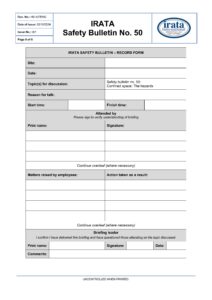
An example ‘IRATA Safety Bulletin: Record Form’ is given overleaf. Members may have their own procedure(s) for recording briefings to technicians and others.